
For Immediate Release:
The American Institute of Architects, Custom Residential Architects Network (AIA CRAN), in partnership with the Association of Collegiate Schools of Architecture (ACSA), have selected the recipients of the 2017 HERE+NOW: A House for the 21st Century Residential Student Design Competition. The competition recognizes seven exceptional studio projects that seamlessly integrate innovative, regenerative strategies within their broader design concepts. The program challenged students to submit projects that provide architecture students, with a platform to explore residential architecture and residential architectural practice.
The jury for the HERE+NOW Housing Competition includes: Aaron Bowman, Liollio Architecture (Charleston, South Carolina); Patricia Seitz, Massachusetts College of Art and Design (Boston, Massachusetts); and Emily Roush-Elliott, Delta Design Build Workshop (Greenwood, MS). The competition had over 560 student and faculty participants and received nearly 200 submissions. The jurors chose First, Second, Third and four Honorable Mentions to be awarded. Listed below are the names of the recipients, their school, the faculty sponsor, and project title.
Listed below are the names of the recipients, the faculty sponsor, project title and their school. You can get more information and see renderings of these projects here:
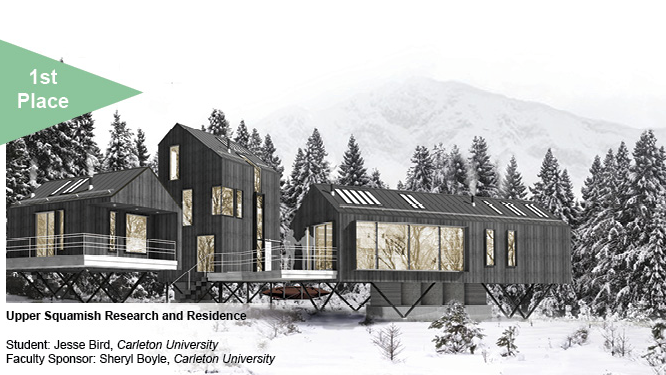
First Place
Student: Jesse Bird
Faculty Sponsor: Sheryl Boyle
Upper Squamish Research and Residence
Carleton University
Second Place
Students: Shannen Martin, Sean Benson, Jabbar Cobbs, Kimberly Montgomery, & Emanuel Soito
Faculty Sponsor: Michelle Pottorf
The Dogtrot Duo Prairie View
A&M University
Third Place
Student: Ariel Scholten
Faculty Sponsors: Elizabeth Golden & Richard Mohler
Common Ground: Collective Living in Seattle, WA
University of Washington
Honorable Mention
Students: Homa Ansari, Anmol Kollegal, & Timothy Massa
Faculty Sponsor: Zui Ng
The Battery House
University of Houston
Honorable Mention
Student: Zachary Henry
Faculty Sponsor: Emily M. McGlohn
Affordable Housing for the 21st Century: A Housing Solution for Poverty in the Neglected Mississippi
Delta Mississippi State University
Honorable Mention
Student: Samantha Geibel
Faculty Sponsor: Taiji Miyasaka
Sliding Canvas House: Transitional Home
Washington State University
Honorable Mention
Student: Jacob Eble
Faculty Sponsor: Mark Stephen Taylor
Revitalizing the Rural University of Illinois, Urbana-Champaign
The selected projects will be on view at the 106th ACSA Annual Meeting in March 2018 and the American Institute of Architects Annual Convention in June 2018.
About the Association of Collegiate Schools of Architecture (ACSA)
Founded in 1912, The Association of Collegiate Schools of Architecture (ACSA) mission is to advance the quality of architectural education. School membership in the ACSA includes over 250 schools in several membership categories. These include full membership for all accredited programs in the United States and government- sanctioned schools in Canada, candidate membership for schools seeking accreditation, and affiliate membership for schools for two-year and international programs. Through these schools, over 5,000 architecture faculty are represented. In addition, over 500 supporting members composed of architecture firms, product associations and individuals add to the breadth of interest and support of ACSA goals. Visit www.acsa-arch.org.
About the American Institute of Architects, Custom Residential Architects Network (AIA CRAN)
The Custom Residential Architects Network (CRAN) Knowledge Community develops knowledge and information to benefit architects who are engaged in, or who are interested in learning more about, custom residential practice. CRAN presents information and facilitates the exchange of knowledge and expertise to promote the professional development of its members via discussion forums, national symposia and conventions, publications, and local activities. Visit www.aia.org/cran.
About the American Institute of Architects (AIA)
Founded in 1857, the American Institute of Architects consistently works to create more valuable, healthy, secure, and sustainable buildings, neighborhoods, and communities. Through nearly 300 state and local chapters, the AIA advocates for public policies that promote economic vitality and public wellbeing. Members adhere to a code of ethics and conduct to ensure the highest professional standards. The AIA provides members with tools and resources to assist them in their careers and business as well as engaging civic and government leaders, and the public to find solutions to pressing issues facing our communities, institutions, nation and world. Visit www.aia.org.