
Do we have a good antonym for AI, Artificial Intelligence? Is it GI for Genuine Intelligence? NI, Natural Intelligence? I might opt for “Real” as the opposite of artifice. In fairness, perhaps, proponents of AI are beginning to walk back to a more euphemistic term: Assisted Intelligence. It’s AI without the threat of losing your career.
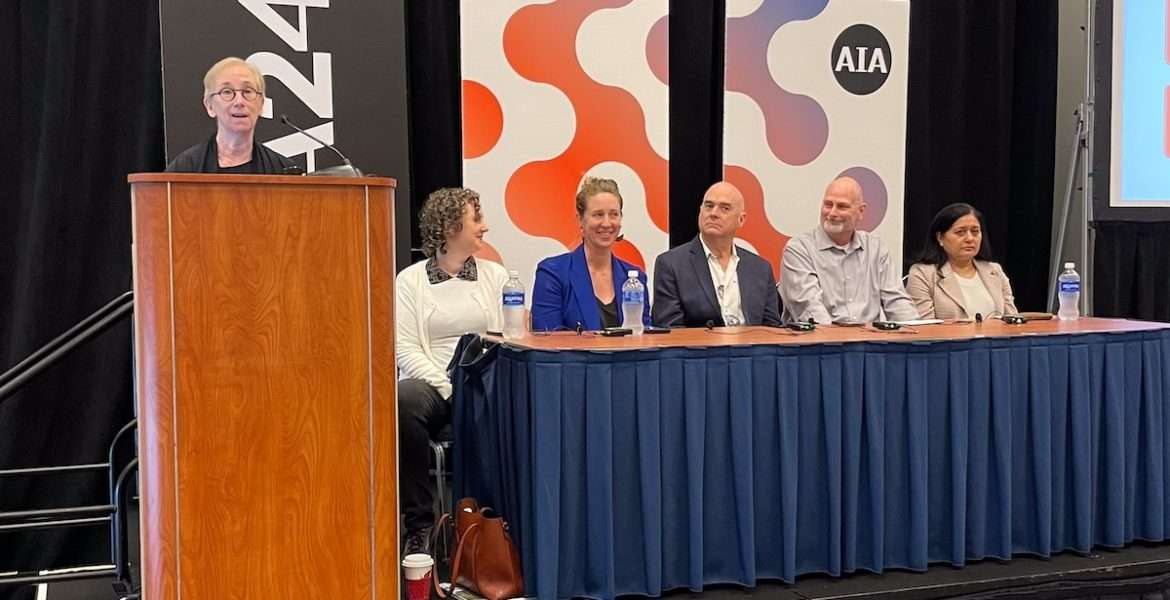
At a time when the term AI is so frequently heard, the CRAN Forum—“Collaboration Next: Best Practices for Residential Architects”—at the AIA National Conference on Architecture served as a reflection on intelligence without a modifier. Practitioners of residential architecture came together to discuss their experiences and offer advice on the best way to do this—where “this” is the art of actual doing. This was not a conversation about the best software platform or the latest communication tool. Our panel discussed the hard-earned experience and knowledge it takes to make good buildings.
Moderated by S. Claire Conroy of Residential Design magazine, panelists Jes Deaver, AIA; Marilyn Moedinger, AIA; Hugh Randolph, AIA; Namita Modi, AIA; and builder Mark Smith of ThinkMakeBuild brought their talents and thoughts to the conversation. The architects are all skilled designers, so the quality of the work is assumed, and Mark’s projects represent home building at its finest. Here, the discussion focused on the other and often unheralded abilities of the day-to-day. We manage budgets, workload, and expectations. In a profession that is too frequently perceived as impractical and oblivious to costs, every panelist had insights into the concept-to-completion process where budgets are at the top of the mind and not afterthought.
Marilyn Moedinger, of Runcible Studios, is a former contractor turned architect. She highlighted, as so many of us do, our roles as managers of expectations, both great and modest. Mark Smith’s construction firm takes its clients through a three-tiered process of pricing from conceptual to hard-bid. Mark formalizes a cost, expectation, and management approach that most of us follow in one form or another. Jes Deaver, of Nick Deaver Jes Deaver Architecture, who has a background as a writer, highlighted that fading skill of communication—the handwritten note. Communication, in its most direct and human touch, is still the best and probably the most appreciated in this very personal act of making architecture.
As the conversation shifted to business trends, we see architects as bellwethers of economic forecast. Our pipeline, or lack thereof, signals underlying strengths and weaknesses in the economy. Most agree there are regional shifts and, of course, changes in design trends: fewer “open concept” floor plans and a long overdue environmental awareness, to name a few. We also seem to be masters of adaptability. Many of our architects were early adopters of virtual meetings, and work-from-home was less of a revolution than an effortless evolution. We navigated our way through the pandemic better than most. As our panel underscored, a life in architecture is a life of problem-solving that breeds ingenuity and flexibility.
Juggling our project schedules and servicing clients is the real art of what we do. Collaboration may be an overused term, but it describes an invaluable skill, nonetheless. On occasion, I’ve been envious of those who work exclusively in sales. Their job, their livelihood, is to sell it. An architect’s job, especially in a small residential office (which most are), is to get the job, keep the job, do the job, and then produce the job. It takes many hats. And the panelists demonstrated that they wear them all very well—and, refreshingly, with RI, real intelligence.
Thank you to this year’s CRAN panelists. We hope to see you in Seattle at our annual AIA CRAN Symposium, from September 18-22, 2024, at the Westin Seattle. Registration opens in late July.
Mark Asher is principal of Asher Slaunwhite + Partners in Jenkintown, Pennsylvania, and chair of the Philadelphia chapter of AIA CRAN.